The young generations of art history writing have now explored almost
everything about the former young art form that preserved professional
traditions, renewed them (or rejected them and enriched them with entirely new
techniques and artistic views), except for the activity of László Gyémánt. Who,
however, not only because of his works, exhibitions, and travels but also
because of his professional friendships, orientation, and international organizing
work, is one of the most significant figures of Hungarian "contemporary art" and the history of its formation.
In downtown Budapest, on July 26, 2025, within the framework of a small
exhibition in the Femme Harmone small gallery, we greet him among his
drawings, pictures of complex technique (photo-based), and paintings.
Read more
Femme Harmone Gallery, July 26, 2025
In downtown Budapest, on July 26, 2025, within the framework of a small
exhibition in the Femme Harmone small gallery, we greet him among his
drawings, pictures of complex technique (photo-based), and paintings.
On the invitation is a black-and-white charcoal drawing: Contemporary Self-
Portrait, with a body belying its fragility, otherwise with about 5/9ths of the
body (from the vertex ‒ the top of the skull ‒ according to the anatomical
dictionary, to the bottom of the pelvis), on which the flesh has slightly sagged.
The hand of his slightly ‒ perhaps naturally ‒ bent, lowered right arm points
further than the line of the groin, while in his raised and bent left hand, the
distorted hand of which thrusts forward almost to the viewer (let us remember
the aggressive poster figures of World War I forcing confrontation-facing),
holding a pencil (would he be left-handed? or is this merely the astounding
deception of the mirror and drawing from the mirror, which might also intend to
shed light on the falseness of the concept of "reflection" much used in
aesthetics?).
The bilateral symmetry of the body is intentionally loosened; its anatomical
segmentation shows a deviation from the proportions of the adult body. The
reason for this can be sought in the size of the facing head, which ‒ in an ideal
case ‒ is merely 1/8th of the whole figure, but here it appears larger, likewise as
if it were approaching (as if leaning forward) to its viewer, inviting a
confrontation/facing with aging. (The beard elongates the head size anyway.)
Slightly above the middle of the picture, a red 90 is readable, written in the
typeface known from "commercial graphics" and the paintings of the 1960s-70s
inspired by them. Its color likewise refers to the former posters of social
movements, but, of course, it is the color of life too, and the regularity of the
digits contradicts the irregular regularity of the declining life as well. The
drawing otherwise consists of dynamic lines and soft tones.
According to our conventions of vision, the eyes, appearing tired and
descending toward the outer edges, look sharply at the viewer, examining the
direct effect of the confrontation-facing. The image as the "tool" of
confrontation-facing is a cultural-social development starting from the so-called
prehistoric age, with varying functions and modes ranging from the religious to
the political and from the communal to self-examination.
With this description, we can say precious little ‒ though we strove for more -
about the draftsman’s preparedness and tools, which ‒ as Gyémánt’s countless
catalogs and several books prove ‒ are his virtues, standing out and excellent
since his youth, emphasized by everyone. He himself always gave thanks for
this to the much-mentioned teacher of the Pest art high school: László Viski
Balás, who taught him from 1950 to 1954. After this, he worked beside applied
graphic artist Pál Szűcs until he was admitted to the College of Fine Arts in
1957.
The young generations of art history writing have now explored almost
everything about the former young art form that preserved professional
traditions, renewed them (or rejected them and enriched them with entirely new
techniques and artistic views), except for the activity of László Gyémánt. Who,
however, not only because of his works, exhibitions, and travels but also
because of his professional friendships, orientation, and international organizing
work, 1 is one of the most significant figures of Hungarian "contemporary art"
and the history of its formation. 2 The volumes published about him, recording
his living memories too, are of documentary value: György Szabó - László
Gyémánt: Dialogue and Monologue (Bp. DFC Publisher and Press, 1995);
Gábor Bóta: Gyémántography (Bp. Duna Book Publisher Ltd, 2006).
We call contemporary - precisely the art renewing itself from the 1960s. As his
Contemporary Self-Portrait made in 2017 and the calligraphic signature 3
appearing in its lower right corner show: the mastery, carrying forward, and
passing on 4 of the former drawing-painting knowledge is the defining,
distinguishing element of his personal oeuvre and art. Initially, this coincided
with the intentions of his college peers and friends: László Lakner or Ákos
Szabó, and the newer and newer career-starting generations (from Gyula
Konkoly to László Fehér 5 ). Critical approaches naming the trends of
contemporary painting (Sur-naturalism, Magic Naturalism, Pop Art) separate the
concordant fact that, namely, it is good to paint, and the more painting
knowledge there is, the more so it is.
On a relatively new picture, perhaps the newest in this exhibition: on the one titled Stratifications (2017-2019), we can see the repository of Gyémánt’s
painterliness: besides the smaller and larger colorful, painterly gestures, on the
pictures (drawn-painted) living in memory (his father’s last self-portrait, 1944; a
childhood photo from Balatonboglár with his mother; portraits of his
grandparents who raised him in early childhood, which we know as pencil
drawings; to the right, the last portrait of Krisztina – his wife until her death; and
his first high school love: Judit) and beyond them: on the flashing and enduring
images of life living in memory itself, and on the portrait of the main figure: the
painter’s student and wife, Edina Ardey, placed in the center, which is completed
and highlighted by the color and symbol of living love: a burning colored (bright
crimson) fish. Painting and life thus show themselves in inseparable unity,
thanks also to the memory living within us. The picture is not a composition, but
an ensemble of stories consisting of pictures and intertwined with gestures.
According to a former idea, an exhibition (or material accompanying an
exhibition) could even be compiled from Gyémánt’s captions. It is definitely a
necessary part of an oeuvre processing.
1. I do not touch here upon Gyémánt’s teaching activity, which began at the
Zebegény art colony, then continued in Óbuda, and was later supplemented with
private students, naturally documented with exhibitions. Attention is drawn to
the importance of creators paying attention to each other by two early Gyémánt
paintings of adventurous fate found in the collection of László Fehér, who also
became a significant art collector: Carnival of the Survivors, 1963, and By-
products of Time, 1963-65.
2. This Pop-Artesque image structure (János Frank once named the 19th-century
popular object form and structure: the quodlibet as its antecedent) was hidden
but already there in By-products of Time or the painting titled Cosmopolis
(1965), which I myself saw in 1967 – as a university student – in the
Mednyánszky Gallery, at Gyémánt’s second solo exhibition (organized by Éva
Körner.) 6 The picture frames in the room of the former picture, and the
architectural space series offered by the arches of the Roman Colosseum in the
latter – painted: a series of planes – could itself show the possibility of the image
structure renewed-multiplied in the picture-in-picture, which coincided with the
contemporary perception-feeling-notion of "Accelerating Time" and "Moving
World" 7.
Several things follow from this: the significance of the intertwining of the barely
graspable life/memory (decomposing into pictures) and painting, the
simultaneous, mutually reinforcing presence of Life and the living arts (etc.) in Gyémánt’s oeuvre. Together ‒ instead of the minute separation of things ‒ these speak of the most important question touching us all: the maintenance of Life
containing billions of differences, its cognition, understanding, and living as
such. Art historian Lóránd Bereczky characterized László Gyémánt as someone
who has a relationship with everything, and his existence/work can be called
human existence for precisely this reason.
Gyémánt was steered toward this by the reading of Camus and existential
philosophy already in his youth. (The coexistence of things, however, can also
spur despair ‒ as his photomontage titled Clinical Picture of Our Century
shows 8 , with the multitude of hands begging for help, reviving former dances of
death or Last Judgment images, from the atomic bomb through the products of
modern industry. Modern industry by now ‒ moreover ‒ replaces the world of
humans with "humans" created by AI, which reap huge successes among people
forgetful of the significance of life, rendered unconscious by civilization ‒
without the pervasive significance of culture or arts and nature. Therefore, the
"word" of a painter deeply experiencing his own age, wanting to know and
understand the world, speaking to the world with his art ‒ such as the 90-year-
old László Gyémánt ‒ is indispensable).
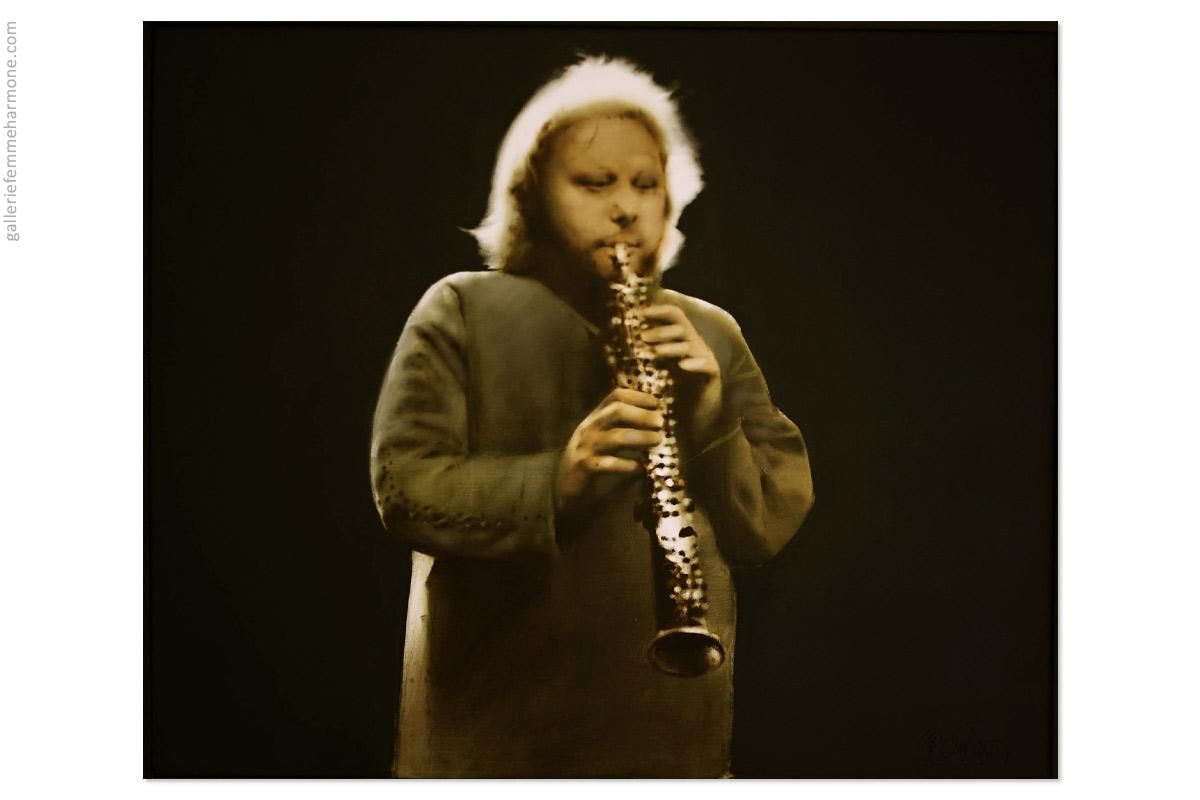
Gyémánt’s countless portraits, among them those of his master: Gyula Hincz
(Master Hincz, 1999), of actors and jazz musicians (here: Tony Lakatos, 2005),
and of blues singers, are examples of the cooperation of the arts, spurring toward
this, raising this tendency that reappeared in his own youth to a continuous
practice. 9 (I merely mention that perhaps his most memorable portraits are those
he made of the actors: Iván Darvas, Dezső Garas, and the others, during the
personal set design of S. Beckett’s drama titled Waiting for Godot, which can
safely be called existentialist /1993-94/, and subsequently.) This opening would
also not be complete without the production of the "partner artists": blues singer
Eszter Lukács and her instrumental accompanist: István Gyárfás. The portrait of
Amerigo Tot first appeared in the picture Cosmopolis following their meeting in
Rome, but since then he has brought the Hungarian sculptor from Rome to life
several times.
3. But the coexistence of differences, the acceptance of the world as such ‒ we
can say ‒ is characteristic of his painting from the start (for example, from
Cosmopolis). We can declare this principle a value, namely through the
qualitative nature of his pictures applying different techniques (imprints,
applications, etc., together with painting.) Quality is just as vital (the condition
of existence) for Gyémánt as when, for example, regarding the catastrophe of the Chernobyl nuclear power plant, he stated: its cause is the insufficiency of the quality of work (and the system financing the work). The generalization of this
standpoint is not only a universal moral question but also the condition of the
survival of culture.
The continuous development of his image-creating technique also happened in
the sign of quality: since the start of his career, he has been a committed devotee
of cameras, and his specific technique was born during the specific processing
of the photo: gyémántography. "Photographer Zoltán Szalay wrote about the
technically manipulated pictures of his black-and-white photo series made of the
Chicago elevated railway, that we cannot call these pictures graphics, nor even
photographs, at most gyémántographies. From then on, I too called my pictures
of this nature ‒ taking it over from Szalay - gyémántographies," says the painter.
Its origin can be linked to his series titled Chicago Blues (1990s): to the Chicago
elevated railway, the functioning ‒ steel ‒ "monument" of the age of
industrialization and rapid mass transport, the modern age, which runs on an
elevated level in the unparalleled ensemble of modern urban architecture and
art: among skyscrapers and giant public statues, and is perhaps the strangest
creation of the turn of the century.
(It is also the inspirer of Imre Oravecz’s volume titled A Short Description of the
Montrose Station of the Chicago Elevated Railway, 2015.) The ground level of
the track held by pillars and monumental V-supports is the scene of numerous
American (chase) films, while blues and jazz play in the premises of the
buildings standing closely beside it. The unity of these elements, inextricably
fused there in experience, inspired the manipulation of the photos made of them
(during development), in the sign of the intertwinedness of speed and stability
(namely music.) Needless to say, America (the USA) drew Gyémánt’s attention
to the cohesion of differences from other perspectives as well (for example,
considering the architecture of Las Vegas.)
To this, we can link the examples of the intertwining of the gigantic creations of
nature (for example, volcanic mountains) and art. The huge heads carved among
the volcanic stone colossi of Rushmore in South Dakota ‒ America’s most
significant presidents: the founding Washington and Jefferson, then Lincoln and
Roosevelt ‒ celebrate the community of the United States, which can also be
called the country of opposites (Made between the two World Wars). It appears
as a stunning national memorial site on the Gyémánt painting made from a color
photo, on which ‒ as on so many snapshots ‒ the painter and his wife lost early,
Krisztina, stand in the foreground. This Anzix (2009) testimony is also an
appreciation of a common homeland (former?), beside the magnificence of the
common feeling.
[1] Documentary volumes published about him, recording his living memories: Szabó György – Gyémánt László: Dialóg és monológ (Bp., DFC Kiadó és Nyomda, 1995); Bóta Gábor: Gyémántográfia (Bp., Duna Könyvkiadó Kft., 2006)
[2] We refer to art that has been undergoing renewal since the 1960s as contemporary art.
[3] According to one idea, Gyémánt's captions could even be used to put together an exhibition (or exhibition accompanying material). This would definitely be a necessary part of any compilation of his life's work.
[4] I will not go into detail here about Gyémánt's teaching activities, which began at the artists' colony in Zebegény, continued in Óbuda, and later expanded to include private students, naturally documented by exhibitions.
[5] The importance of artists paying attention to each other is highlighted by two early paintings by Gyémánt with eventful histories, now part of the collection of László Fehér, who has also become a significant art collector: Carnival of the Survivors, 1963, and By-products of Time, 1963–65.
[6] At that time, the galleries were owned and operated by Képcsarnok Vállalat, i.e. the state.
[7] The former is the title of Magvető Publishing House's book series presenting current scientific
knowledge, while the latter is the title of its magazine presenting the artistic life of the era in the 1970s.
[8] More precisely: a black-and-white painting based on a photomontage, 1963.
[9] Amerigo Tot's portrait first appeared in the painting Cosmopolis, following their meeting in Rome, but
since then he has brought the Roman-Hungarian sculptor to life several times.