Parvathy Baul: Bhava Pagla meditating in the womb of a banyan, 2005
Dimensions: 48.5x19.5 cm, Medium: Woodcut, Sakura ink on japanese paper
Price: 3.000 €
Bhaba Pagla was born in 1902, in the village Amta of Manikganjo, Dhaka in Bangladesh. He was born in a Shakta family. Bhaba Pagla was the sixth child of his parents. As a child he grew up in a spiritual environment, and these circumstances developed in him a very humble and sweet disposition. From a very young age he was tuned to spiritual presence within. He was reluctant to pursue conventional education. In his teenage years he used to sing Kirtan to the Kāli idol that was established in his ancestor’s house. He used to write songs of his instinctive poetry. In many of his songs we can see Krishna, Kāli, Shiva all become one. In 1947 he moved from East Bengal to Kalna in Burdwan with his Kāli idol. He had established a Kāli temple there. Bhaba Pagla established six or seven Kāli temples on both sides of Bengal. This woodcut depicts the great master as if sitting in the womb of a banyan tree and looking at the world.

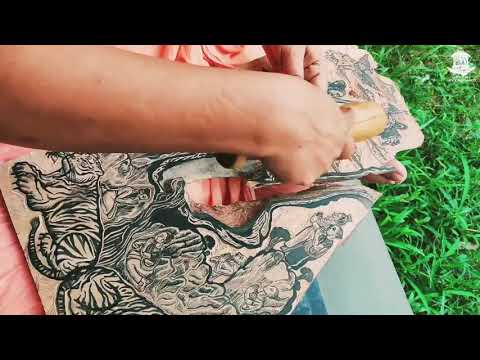
Parvathy Baul: Maha Guru Atal Bihari Sai Dervesh with his two pet tigers, 2021
Dimensions: 47.3x31.5 cm, Medium: Woodcut, Sakura ink on japanese paper
Price: 3.000 €
Five hundred years ago this great master lived. He belonged to Baul Vaishnav Dervesh parampara in the sacred hill of Mama Bhagne in Birbhum district, West Bengal. He did his meditation and created Yonipith in the hill. This is now considered a sacred pilgrimage space for many Baul practitioners. It is said that he had many tigers around and two of them were his pets and named them Nanke and Manke. In this woodcut, Atal Bihari Shai is seen seated on the hill top at his sadhana space. Many Baul practitioners are paying homage to him and his two pet tigers at the base of the sacred hill.
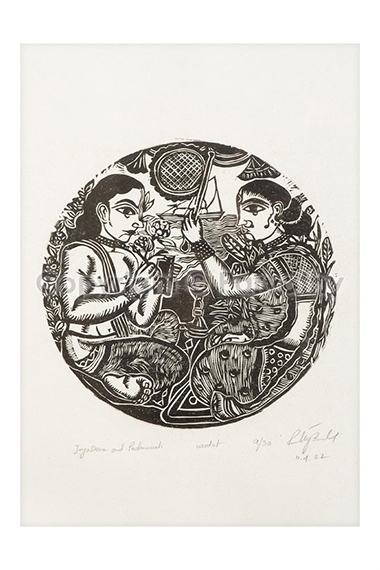
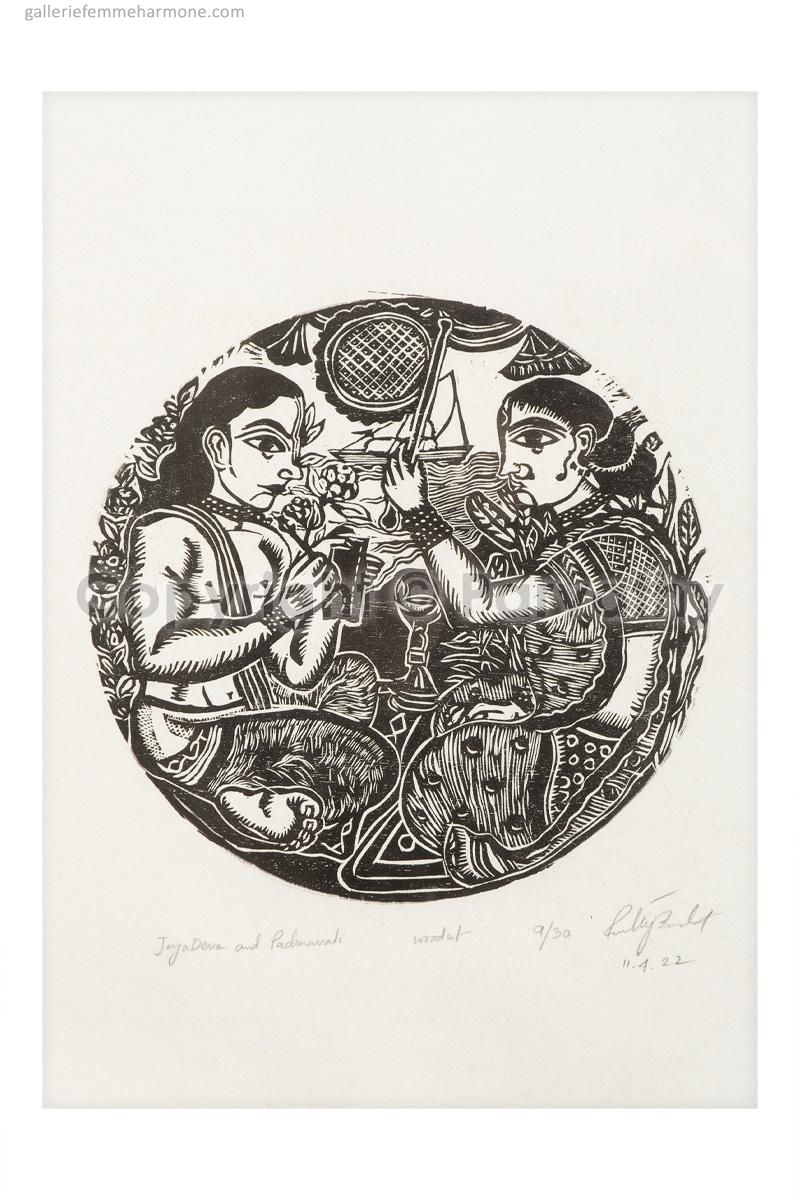
Parvathy Baul: Poet Jayadeva and Padmavati (Navarasik Series – 3), 2005
Dimensions: 20.5x21 cm, Medium: Woodcut, Sakura ink on japanese paper
Price: 2.000 €
Jayadeva is considered foremost among the Navarasik. He immortalised the playful acts of devotion between Sri Radha and Sri Krishna in his epic poem Gita Govinda. This work stands tall even after several centuries, as it never fails to fuel the inspiration of both artists and spiritual practitioners. There is a famous story associated with the composition of Gita Govinda, where it is believed that when Jaya Deva was stuck in completing the composition of a particular verse, Sri Krishna himself came and completed this composition. Sri Jayadeva belonged to the 12th century and he married Padmavathi who also stood by him as a spiritual companion. In this woodcut they are seen sitting beside river Ajay. Jayadeva is seen reciting a poem while Padmavati is listening to him and fanning him with a hand fan.
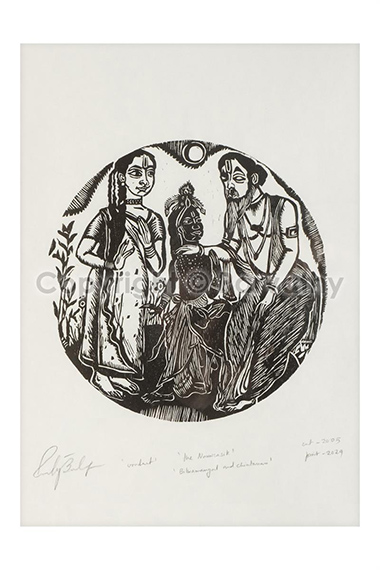
Parvathy Baul: Krishna leading the path of Bhakta Bilwamangal to Chintamani (Navarasik serie – 1), 2005
Dimensions: 19x18.6 cm, Medium: Woodcut, Sakura ink on japanese paper
Price: 1.500 €
Bilwamangala Swami also known as Lila Suka is the author of one of the seminal Vaishnava Bhakti works titled Sri Krishnakarnamrutam.
His place of origin is largely speculated. Some scholars consider his native origin to be in the southern part of India.
In his early life he was deeply attracted to a woman by the name Chintamani.
There are various versions of this story, the essence of it being that Chintamani plays a pivotal role in making Bilwamangal realise the ephemeral nature of the mundane world filled with desires. Thus effecting a transformation of his mind to turn completely towards Krishna.
He pays homage to Chintamani for being his teacher in the very first verse of his master composition Sri Krishnakarnamritam.
Legend has it that even Sri Chaitanya Mahaprabhu was deeply impacted by this work and set many disciples on the task of writing down this seminal work.
In this woodcut, Sri Bilwamangala’s final journey to Brindavan is being depicted where he was eventually led by Sri Krishna himself.
Sri Krishna tells Bilwamangala that Chintamani has already reached Brindavan and blind Bilwamangala Swami is approaching her holding Sri Krishna’s hand.
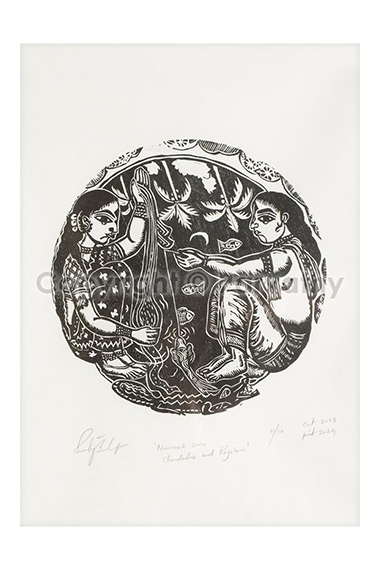
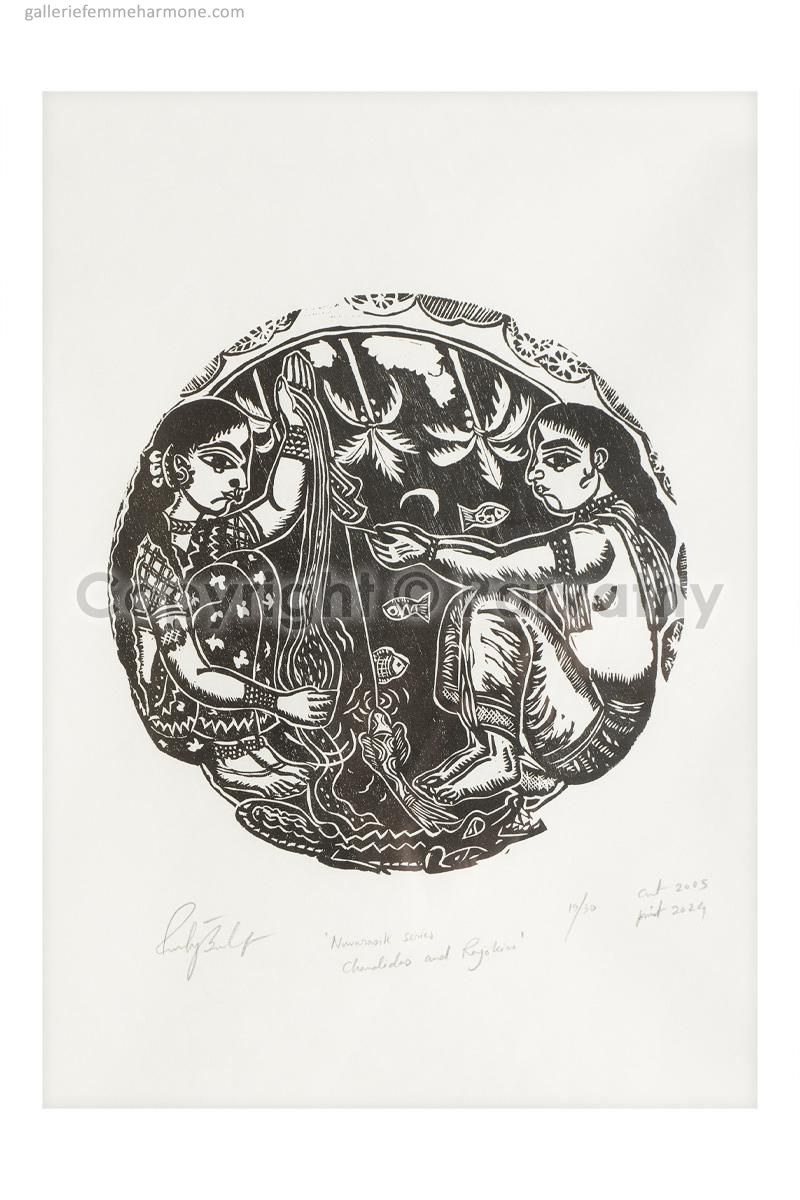
Parvathy Baul: Poet Chandi Das and Rajokini (Navarasik Series – 2), 2005
Dimensions: 20x25 cm, Medium: Woodcut, Sakura ink on japanese paper
Price: 2.000 €
Chandidas is considered as one of the foremost Devotional poets of Bengal. His devotional fervour is unsurpassable. Scholars date his works to the early 15th century. His works include over one thousand devotional poems all centered around love of Radha for her beloved Sri Krishna. He was also one of the earliest Bengali language poets. His relationship with Rajokini, who was considered to belong to the lower strata of society, turned out to be a deep source of his inspiration and spiritual sadhana. This woodcut depicts the story of Chandidas sitting near the pond and catching fish, where Rajokini used to wash the clothes. They never spoke to each other all this while. Twelve years passed thus, and one fine day Rajokini asked Chandidas if he had been trying to catch a fish for twelve years, has he ever caught one? Chandidas replied “yes, today I have caught one.”

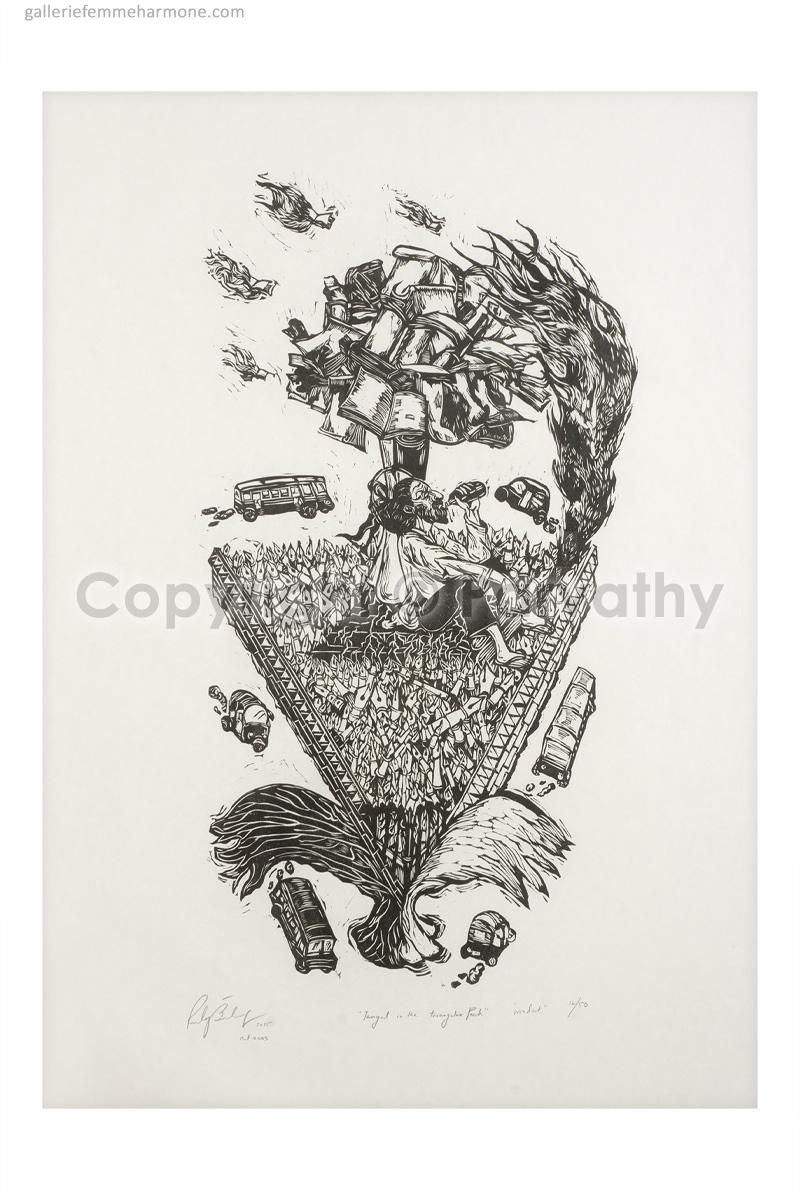
Parvathy Baul: Maha Guru Thangal at the Street Side park, 2010
Dimensions: 55x29.1 cm, Medium: Woodcut, Sakura ink on japanese paper
Price: 3.500 €
Mahaguru Thangal was a great Siddha who belonged to the school of Mast Kalandar. He lived his life in Trivandrum, was born in Muslim family, Nedumangad, and studied Arabic. At a very young age he became the Maulvi of a Mosque. Then he met Gafoor Ali of Ajmer Sharif, who transmitted spiritual teaching to Mahaguru Thangal which unfolded into a mystical journey. Ever since that special event, Mahaguru Thangal gave up his life as a scholar and religious priest. He became Mast and moved in the lanes of the small town of Nedumangad for years. Local people have witnessed many instances of miraculous healing by this master. People started calling him Thangal, meaning respected spiritual elder.
This woodcut depicts a key phase of his life. Here Thangal is seen sitting in the triangular space in the middle of the road. Triangle depicts Goddess Bhadrakali of whom Mahaguru Thangal was a great devotee. He is seen seated on the nibs of the pen while books are being burnt in the flame. This image depicts his transition from being a scholar to become a spiritual master. His space of spiritual practice was always a busy and noisy street. He is seen drinking alcohol and smoking, depicting his attitude of non-conformism with conventional ways of life.
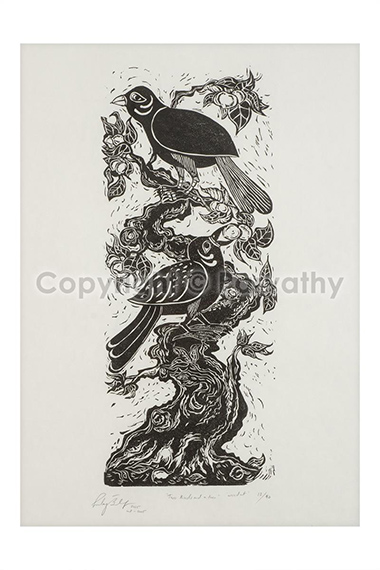
Parvathy Baul: The two birds and the tree, 2005
Dimensions: 47.5x20 cm, Medium: Woodcut, Sakura ink on japanese paper
Price: 3.500 €
द्वा सुपर्णा सयुजा सखाया समानं वृक्षं परिषस्वजाते । तयोरन्यः पिप्पलं स्वाद्वत्त्यनश्नन्नन्यो अभिचाकशीति ॥द्वा सुपर्णा सयुजा सखाया समानं वृक्षं परिषस्वजाते । तयोरन्यः पिप्पलं स्वाद्वत्त्यनश्नन्नन्यो अभिचाकशीति ॥द्वा सुपर्णा सयुजा सखाया समानं वृक्षं परिषस्वजाते । तयोरन्यः पिप्पलं स्वाद्वत्त्यनश्नन्नन्यो अभिचाकशीति ॥द्वा सुपर्णा सयुजा सखाया समानं वृक्षं परिषस्वजाते । तयोरन्यः पिप्पलं स्वाद्वत्त्यनश्नन्नन्यो अभिचाकशीति ॥
dvā suparṇā sayujā sakhāyā samānaṃ vṛkṣaṃ pariṣasvajāte |
tayoranyaḥ pippalaṃ svādvattyanaśnannanyo abhicākaśīti ||
Mundaka Upanishad, 3.1.1
Translation : „Two inseparable companions of fine plumage perch on the self-same tree. One of the two feeds on the delicious fruit. The other, not tasting it, looks on.”
This woodcut is inspired from the Upanishadic verse from Mundaka Upanishad.
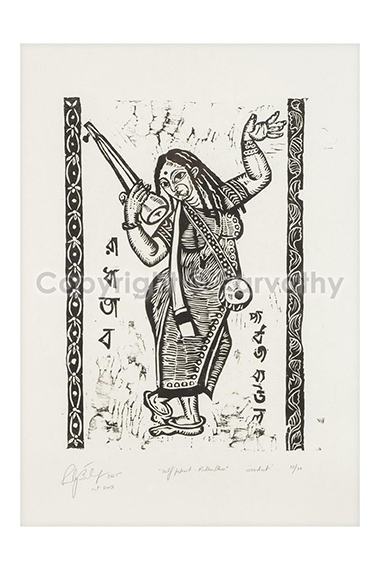
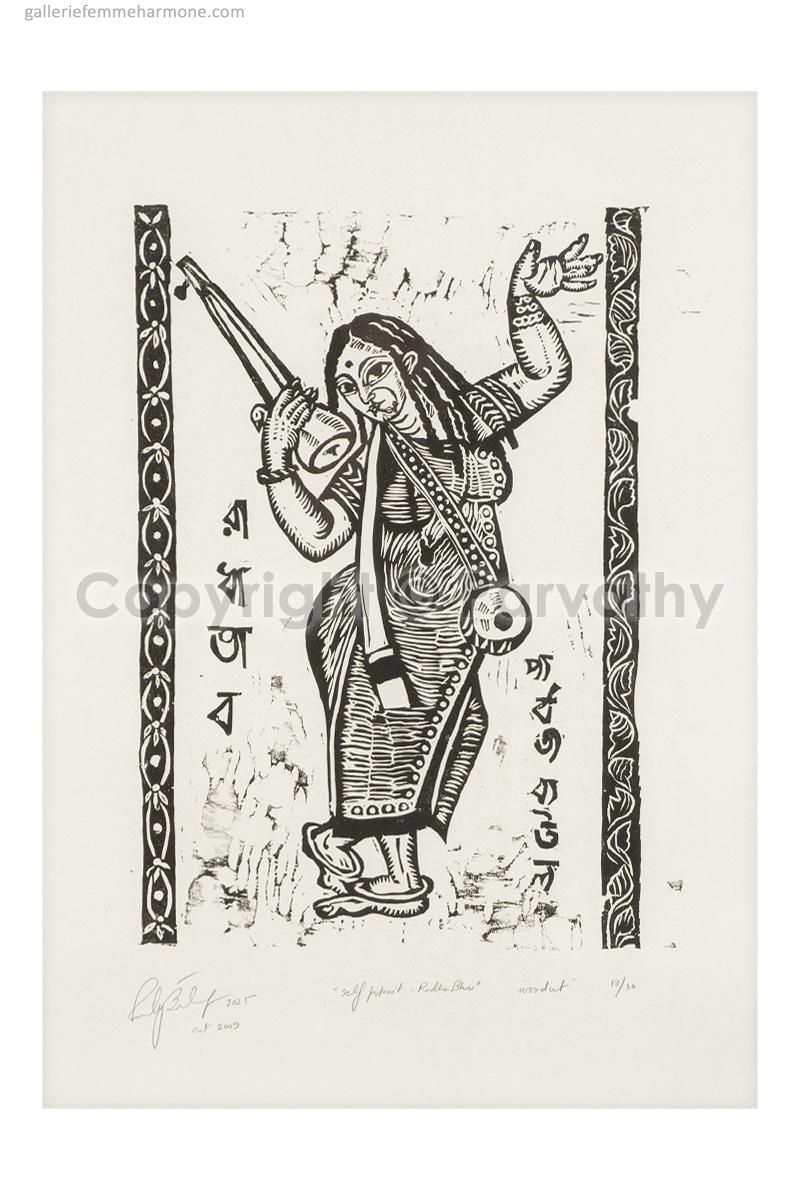
Parvathy Baul: Rádhá-bháva, 2005
Dimensions: 31.2x28.1 cm, Medium: Woodcut, Sakura ink on japanese paper
Price: 3.000 €
This is a self portrait.
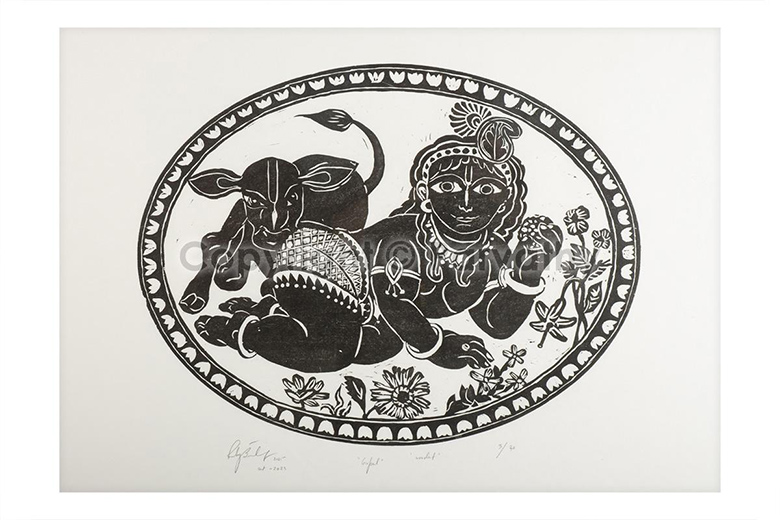
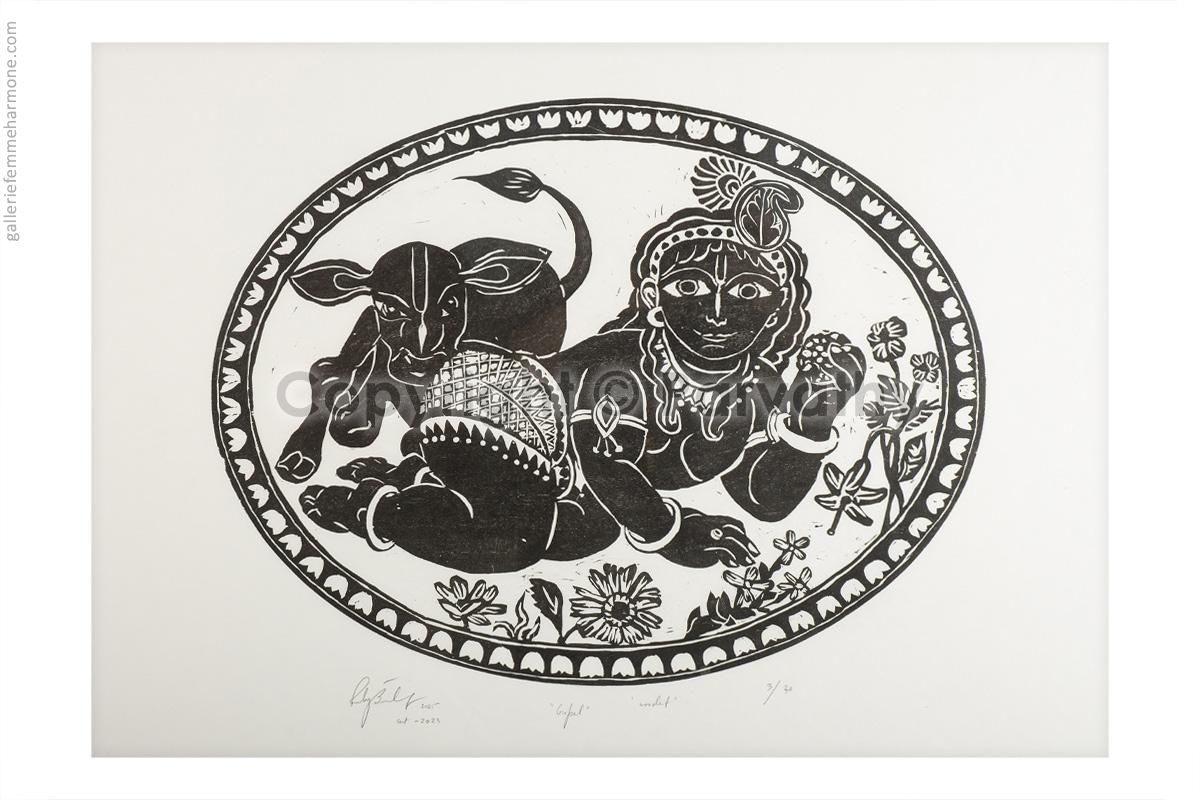
Parvathy Baul: Bala Gopal, 2021
Dimensions: 24,5 x 38,2 cm, Medium: Woodcut, Sakura ink on japanese paper
Price: 3.000 €
This is a translation of the simple vision of the deity Bala Gopal whose playful loving nature allows the devotee to melt into his innocence. In this artwork he is accompanied by a beautiful calf. Parvathy Baul brings a unique facet into this artwork by invoking Mother Kali’s presence in the eyes of Bala Gopal.
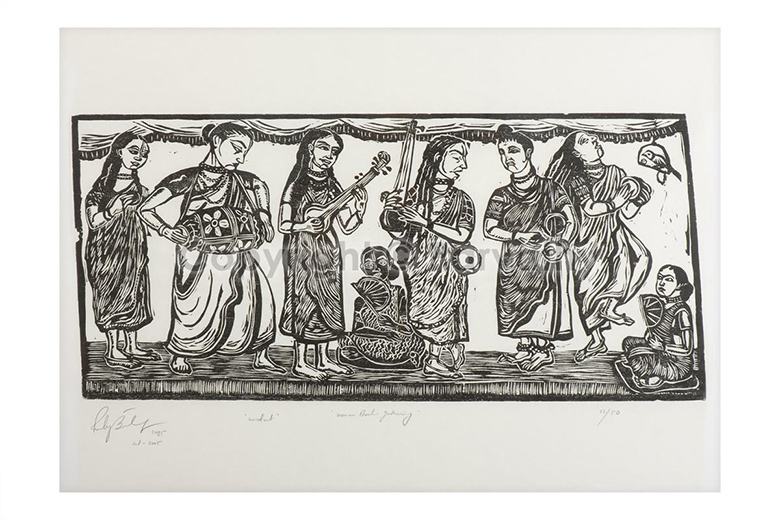
Parvathy Baul: Women Baul Gathering, 2005
Dimensions: 22.1x46.8 cm, Medium: Woodcut, Sakura ink on japanese paper
Price: 3.500 €
There have been many women Baul practitioners through the centuries. We know very little about them. They were great musicians, composers and Sadhaks. This woodcut depicts my imagination of ancient times when such female Baul masters would gather.
Here is the song of the poet Sarot which I imagined as the seeking of a woman’s heart.
Desire in the morning,
Desire in the night,
Desire throughout the day,
If I forsake desire,
Desire nonetheless comes to catch me
Another way.
Better would be the funeral pyre,
Then, at least, the whole man would burn;
But the fire of desire
Kills not, just sears, keep on searing.
Sarot sings:
Oh, Lovely Radha,
In the end you stand lonely,
Except for the desire;
Is it the one who heals
The wounds of all worldly desires
The one you desire?
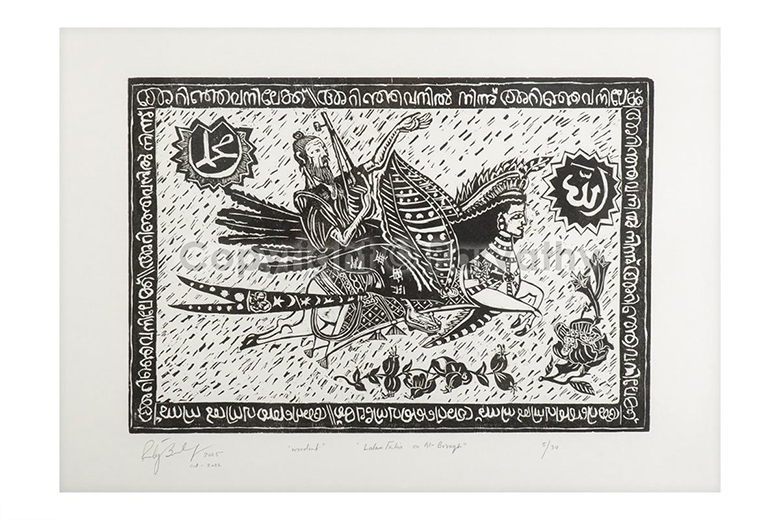
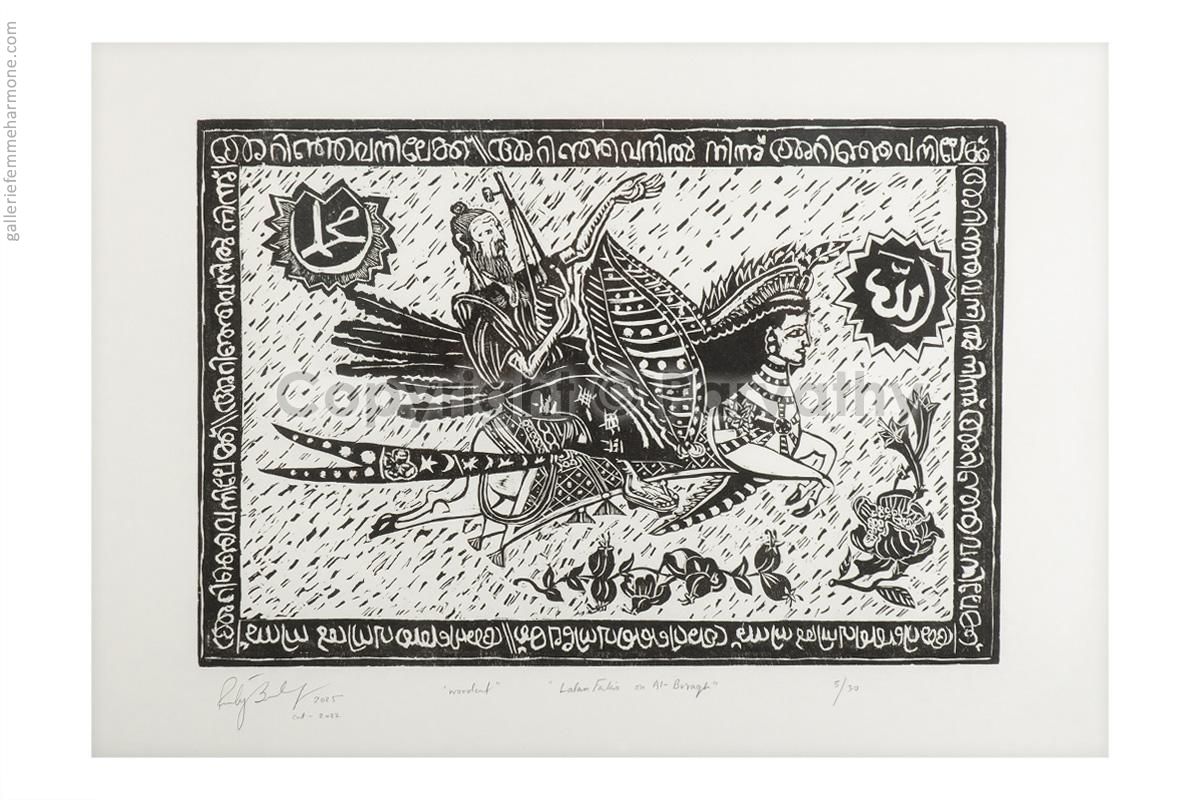
Parvathy Baul: Lalon Fakir Travelling on Al-Buraq
Dimensions: 27.4x39.6 cm, Medium: Woodcut, Sakura ink on japanese paper
Price: 3.000 €
Lalon Fakir is like the Sun of the Shai Fakir tradition of erstwhile undivided Bengal region. His life and poetry flowered in the 19th Century. His life’s message still courses through like a strong river in the mind and hearts of the people of Bengal. Having experienced religious conflict from close quarters, he emerged as a fierce critic of identity based conflicts. His songs always spoke about the freedom that is beyond all identities. It is said that he lived over a hundred years. His tradition still continues near Kushtia, Bangladesh. Every year thousands of his devotees gather in his Akhara-Majhar on the occasion of his death anniversary.
Al-Buraq is a miraculous steed from the heavens which transported the enlightened beings. Lalon himself used these images often in the songs. This woodcut depicts Lalon Shai being carried towards the Divine light on the Al-Buraq. This is depicted as his final journey. The journey is summed up in Malayalam phrase “from what one knows to one who knows.” This phrase is etched in the border of the wood cut. This was the teaching from Mahaguru Thangal.

Parvathy Baul: The womb song – 1 (Jeeva’s First Step), 2005
Dimensions: 25x20 cm, Medium: Woodcut, Sakura ink on japanese paper
Price: 1.500 €
This is a reflection on the poetry written by Bangladeshi composer Sarat (also known as Dino Shorot). He was born in the village of Sajiura, Kendua, district of Netrokona in Bangladesh. Shorot was born into a poor family. His full name was ‘Shorot Chandra Debnath’, but he was popularly known as ‘Blind poet Dino Shorot’. This woodcut is specifically inspired by the poem based on the Deha Tattva (wisdom of the Body).
Oh my heart! Don’t you remember
That tiny abode?
There, once you lived,
Your body upside-down.
With the seed of parents and desires,
You entered the Mother’s womb;
You took the shape of your body.
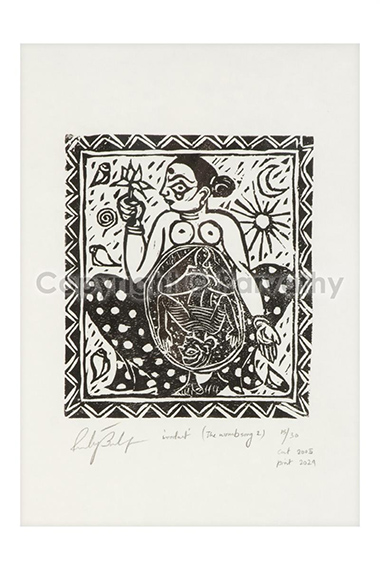
Parvathy Baul: The womb song, 2005
Dimensions: 17.3x15 cm, Medium: Woodcut, Sakura ink on japanese paper
Price: 1.500 €
This image is a reflection on the poetry written by a Bangladeshi composer Sarat or Dino Shorot. He was born in the village of Sajiura, Kendua, district of Netrokona in Bangladesh. Shorot was born into a poor family. His full name was ‘Shorot Chandra Debnath’, but he was popularly known as ‘Blind poet Dino Shorot’. This woodcut specifically draws its inspiration from the poem based on the Deha Tattva (wisdom of the Body).
There, once you lived,
Your body upside-down.
No Sun, no moon.
In the dark you waited
Under water, ten months.
The Lotus of the Navel
Connected to the Mother’s cord
Fed you.

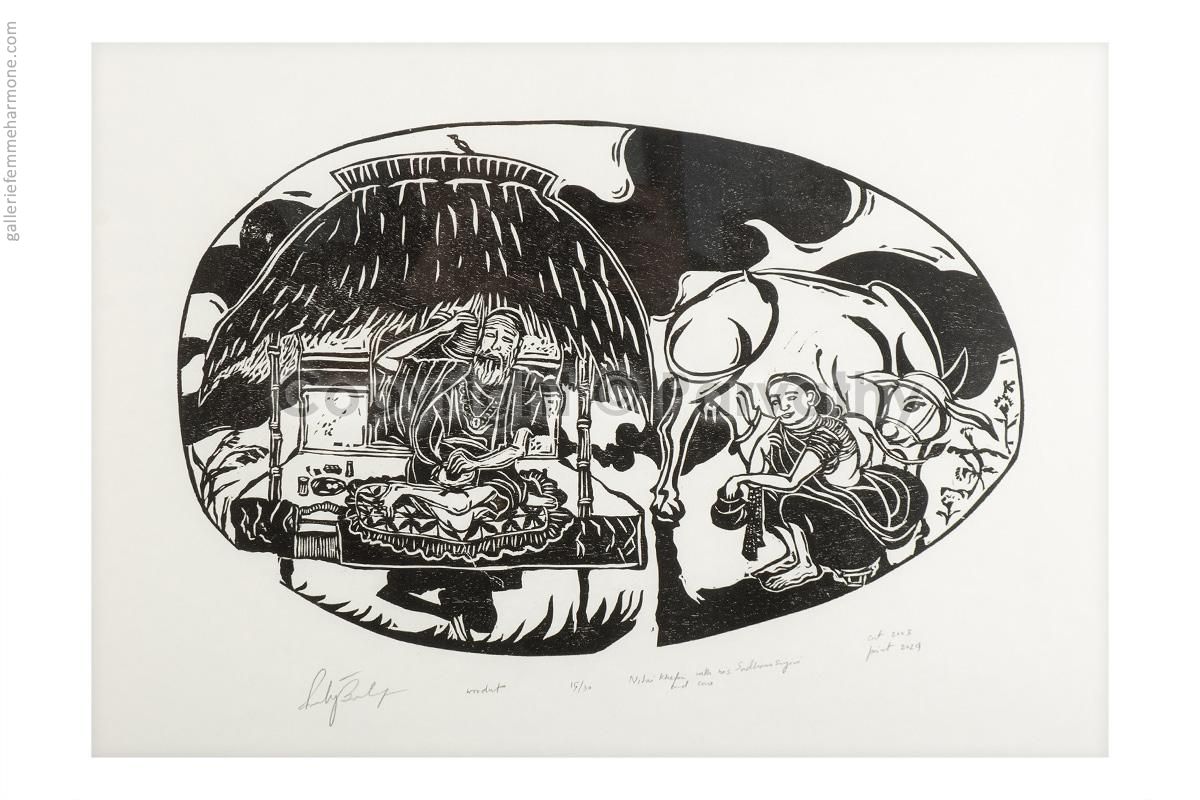
Parvathy Baul: Nitai Khepa sitting in his ashram, 2005
Dimensions: 24,5x38,2 cm, Medium: Woodcut, Sakura ink on japanese paper
Price: 2.500 €
Nitai Khepa was a great yogi who lived in Betalbon Dwarnori, an interior village in the district of Burdwan, West Bengal. He lived in a small hut ashram with his consort Mata Ma, and a cow and her calf. Sri Hari Goshai initiated and guided Nitai Khyapa in the Baul path. If he was to sing in a Sadhu gathering, many devotees from far away villages would come and gather. Nitai Khyapa’s Duggi and Ektara are as legendary as his songs, Sadhana and stories. His Ektara was made of bell-metal, and the Duggi was made of copper. He used to dance with the anklets “Nupur”. When Nitai Khyapa performed the Baul songs, he used to make his listeners sit in two parts. He would create a narrow lane between the two groups. He would move back and forth, up and down the narrow lane singing and dancing; in between he would explain the songs with simple stories and humour.
He used to dance and move his body a lot and do a lot of hard work to bring pure expression for the Bhava of the song. Sweat would gather on his forehead, then his face, and then the whole body. The more his body was drenched in the sweat of physical exhaustion, the more he was in deep joy in a plane that could be accessed only by spiritual masters. He experienced something so sweet through his offering of songs that he would often experience bhav samadhi. In this woodcut, Nitai Khepa is seen sitting in his hut and composing songs during the month of ashada i.e season of monsoon. His spiritual consort Mata Maa is collecting milk from his only cow.
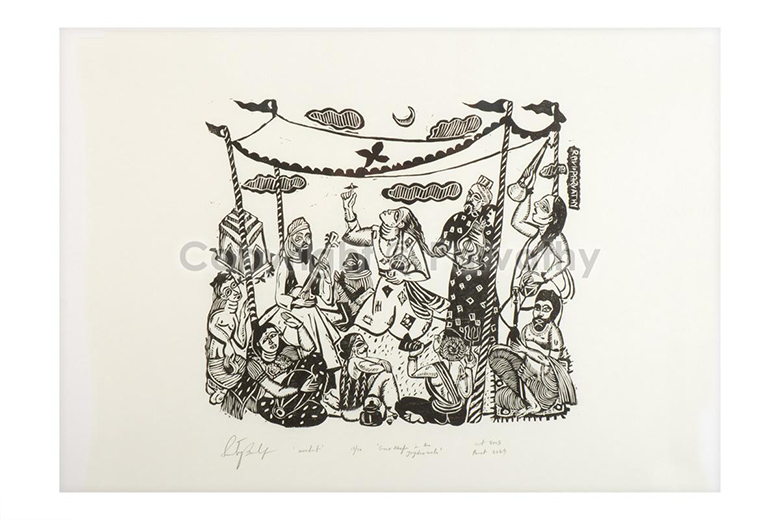
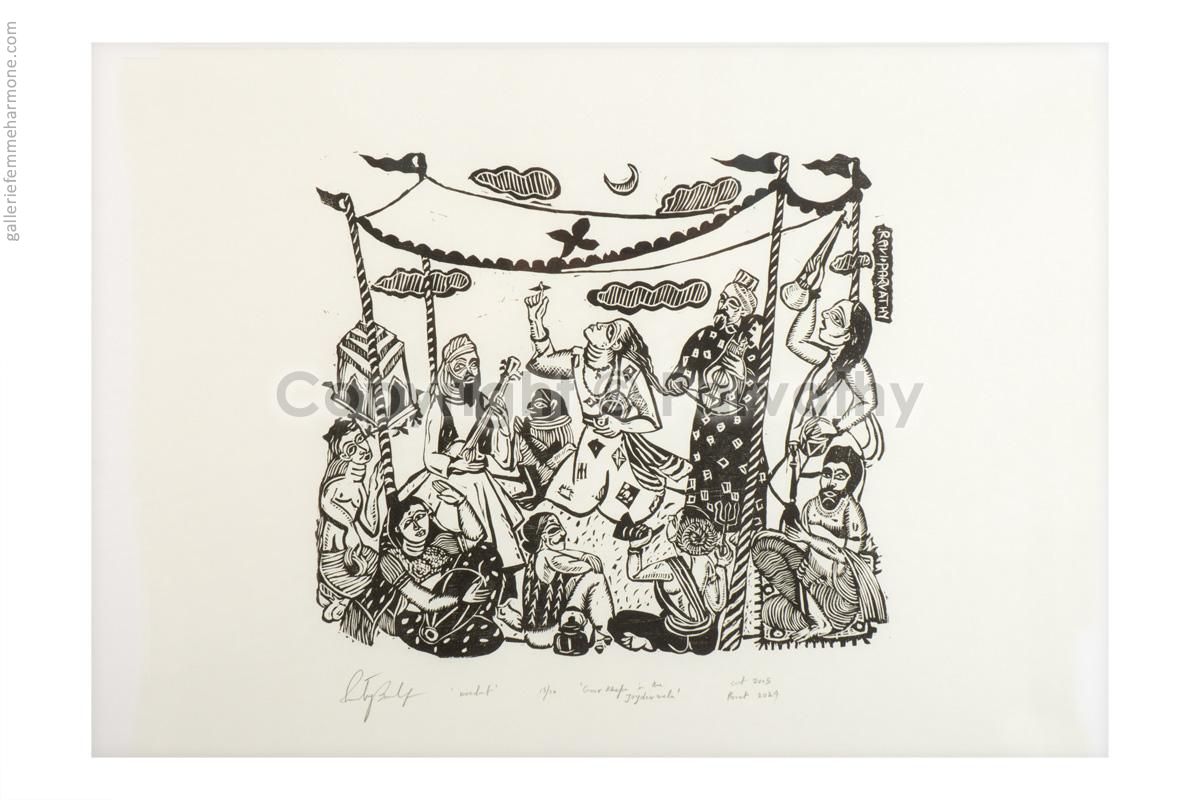
Parvathy Baul: Gour Khepa singing at Joydeb Mela, 2005
Dimensions: 28x32,2 cm, Medium: Woodcut, Sakura ink on japanese paper
Price: 2.500 €
In my travels I have met several Baul masters. Among them, I met a quite remarkable Baul performer called Gour Khepa. Though this Khepa always left everyone on their toes on many occasions, my memory of him is when I saw him singing while jumping very high in the Joydeb mela. In this woodcut he can be seen in the centre levitating. And the song he was singing was composed by Padma Lochan and the song title is The Magic Market.
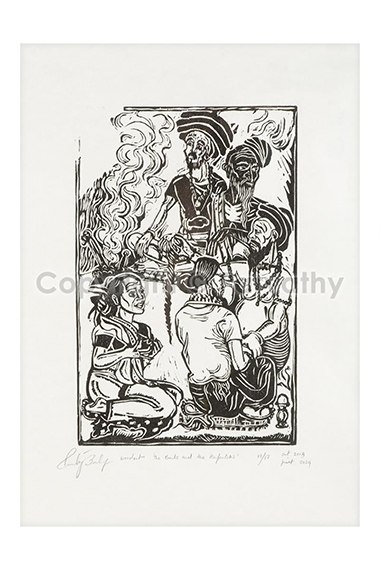
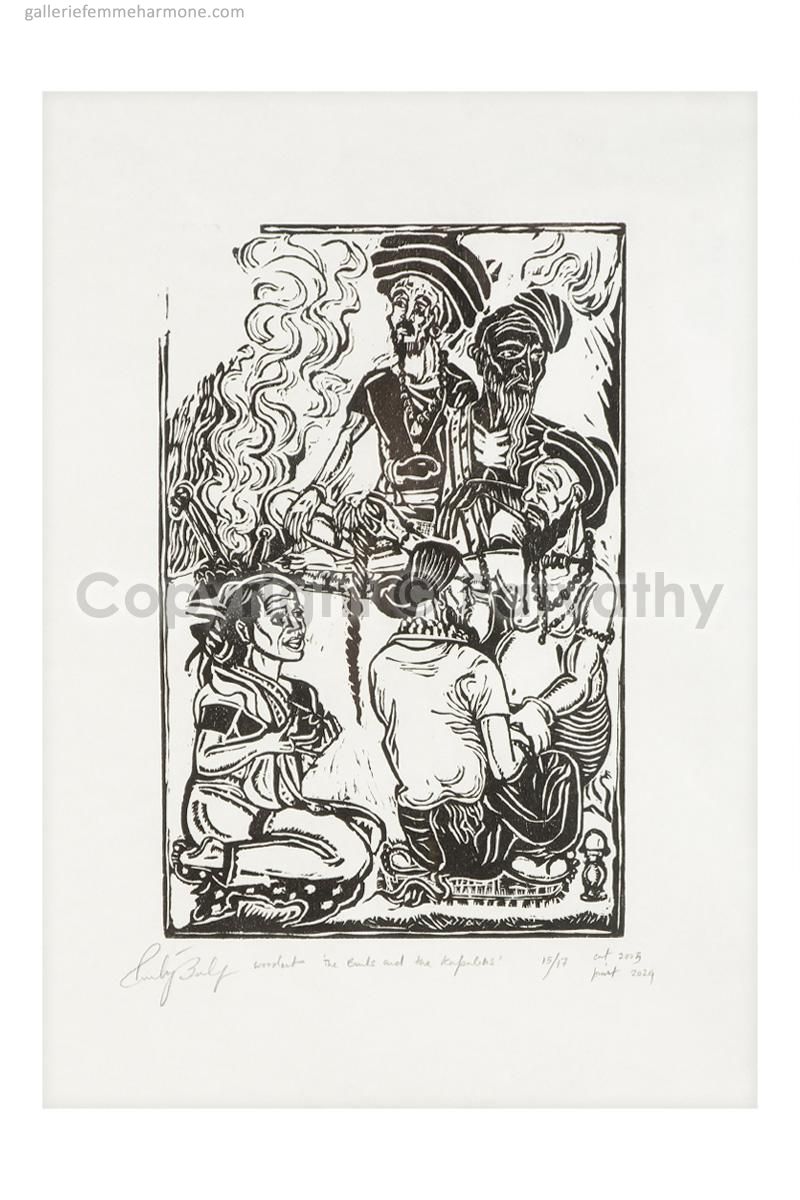
Parvathy Baul: The Female Baul singing for Kapalik Sadhu at the Burning ground, 2005
Dimensions: 25.5x17 cm, Medium: Woodcut, Sakura ink on japanese paper
Price: 2.000 €
This woodcut depicts my memory of the Kapaliks and Aghori Sadhus I met who live mostly in the Smashan. During my early years of seeking and searching, I often used to visit them in Smashan and spend long hours listening to their discussions; I also used to sing for them. I remember them as some of the most compassionate beings I met in my life.

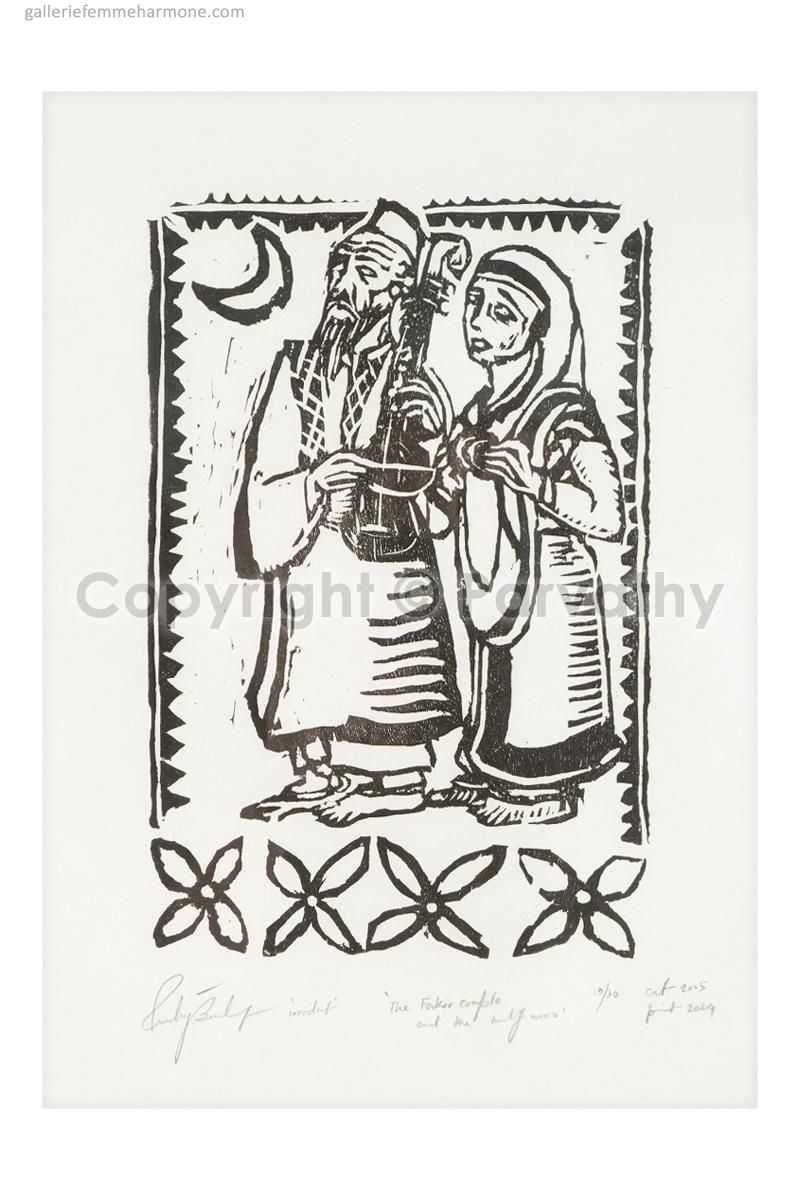
Parvathy Baul: The Fakir Couple and the Half moon, 2005
Dimensions: 25,4 x 17 cm, Medium: Woodcut, Sakura ink on japanese paper
Price: 2.000 €
This woodcut depicts the school of Fakirs, which is a stream in the Baul parampara. The blind fakir is standing with a Sarinda in his hands, a unique string and bow instrument from Bangladesh. This instrument represents the music of the ascetics. The half moon is the sign of their practice which is known as “four moon practice”. Both Fakir and Baul are paths practiced in a couple. This is an obeisance to the streams of the Fakirs. The following poem written by Lalon Fakir depicts this unknown moon.
Oh, listen, how’ll you
Touch that unattainable moon?
Millions and millions of moons
Display their splendour;
In the middle shines the elusive moon.
Seeing that Bazaar of moons,
Swoons.
Be at your own risk
You may get a knockout
From the tree of embodiment

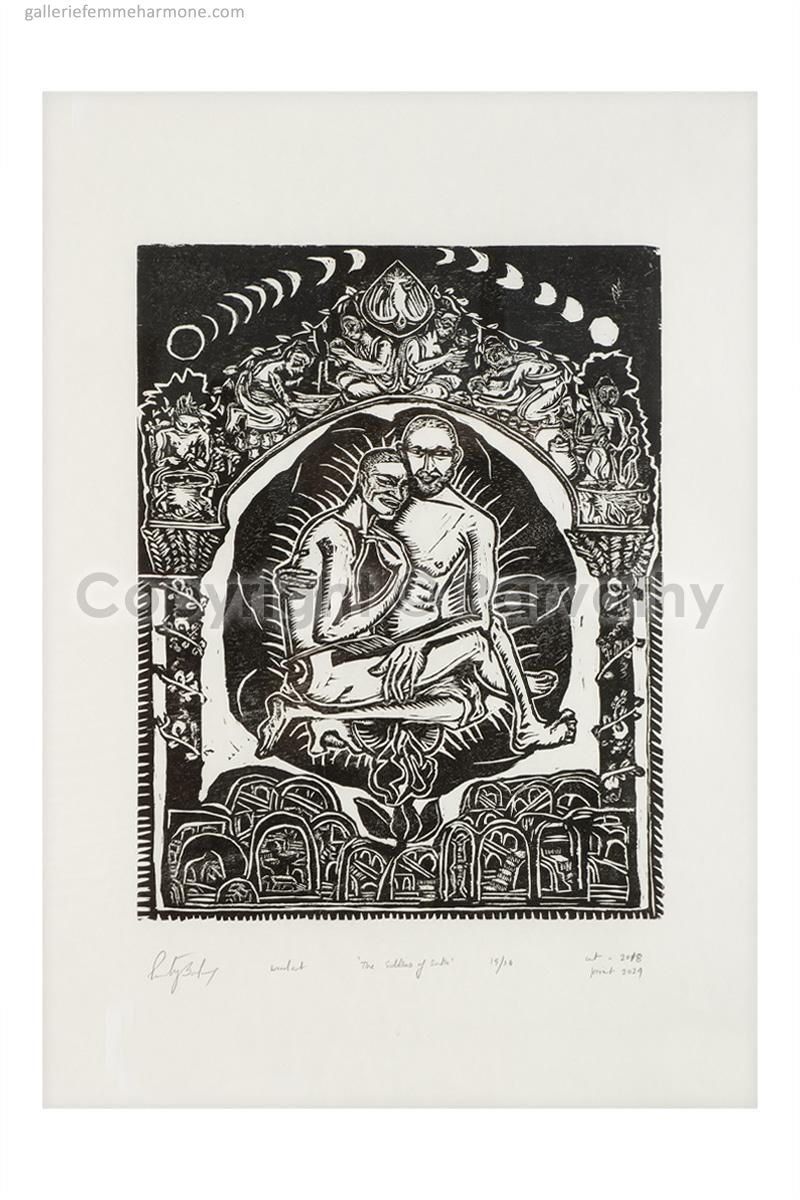
Parvathy Baul: The two Siddhas of South (Nityananda in Shivananda’s lap), 2018
Dimensions: 34.6x27.1 cm, Medium: Woodcut, Sakura ink on japanese paper
Price: 2.500 €
There lived a great master, a perfected being, in Kerala who is known as Swami Shivananda. He was initiated by the great Siddha Bhogar through the subtle body. With the guidance of his guru, he created Siddha Samaj. It is basically a community of Siddhas. Besides sadhana, they also developed their knowledge about various aspects including Siddha medicine. In this woodcut Swami Shivananda is seen holding his disciple Swami Nityananda in his lap. The pillars depict the establishment of siddha samaj. On top, at Siddhashram, they are seen making siddha medicine. Below is the cave for the sadhaks built by Swami Nityananda.
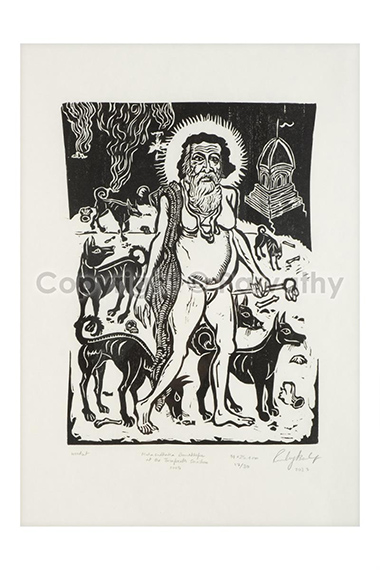
Parvathy Baul: Maha Sadhaka Bamakhepa in Tarapith Smashan, 2005
Dimensions: 34x25.4 cm, Medium: Woodcut, Sakura ink on japanese paper
Price: 3.500 €
Bamakhepa is regarded as one of the great Shakta Siddha from Bengal. He resided all his life in the sacred funeral ground of Tarapith in Birbhum district of West Bengal. He was a devout sadhak of the Divine Mother Tara. Goddess Tara in Tarapith is considered Smashan Tara i.e specific form of Goddess Tara presiding over the funeral ground. She is adorned in an Ugra form, meaning a fierce form. Doing her Sadhana demands great courage and an attitude of fearlessness. Bamakhepa was called Khepa, which in Bengali means ‘Mad one’. His life story evokes deep devotion. He was the contemporary of Sri Ramakrishna Paramahamsa. Thus, the land of Bengal was doubly blessed with two spiritual greats at the same time. His devotees consider him as the Bhairava of Tarapith. This woodcut depicts the Bhairava aspect of Bamakhepa. He is surrounded by dogs who are special beings residing in the funeral ground. The presence of a black dog depicts Bhairava tattva. One can see the pyres burning and in the background depiction of Tarapith temple can be noted. During old times, this temple was a simple structure with a main worship space for the Goddess. However it is difficult to fathom where Her sphere of energy begins and ends as Her presence pervades all through this sacred funeral ground.

Parvathy Baul: MAYA, 2005
Dimensions: 18.5x25.2 cm, Medium: Woodcut, Sakura ink on japanese paper
Price: 1.500 €
Maya is the power of illusion that continuously keeps us engaged with the world. In this woodcut Maya is depicted as someone riding the rickshaw pulled by us. Pulling of the rickshaw depicts the burden and bondages of the material world. The rickshaw puller represents a worldly being. The several heads of the rickshaw puller depict several minds pulled into many directions while Maya is enjoying the ride.
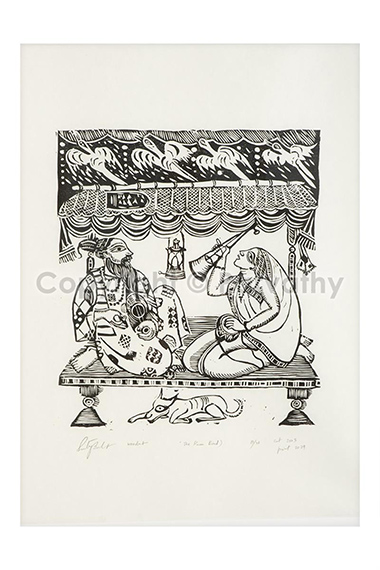
Parvathy Baul: The Rain Bird, the Chataka / Lalon Fakir, 2005
Dimensions: 30x27.3 cm, Medium: Woodcut, Sakura ink on japanese paper
Price: 3.000 €
This woodcut is based on the song of Lalon Fakir.
Can you drink the water
Of the elixir-cloud,
Just with spoken words,
If one’s nature is not of a chataka?
The fate of the Chataka
Even if it dies of thirst,
It won’t drink any other water,
Nothing but rain drops.
The clouds cheat it many times,
Still, the chataka, self-enchanted
Enjoyer of those clouds;
If one’s eyes are transfixed on
The goal, as a chataka
He’s called the Sadhaka
Single minded seeker of Truth
My being, like the passing wind
Always in flight, day and night,
Lalan says: my being
Waits not in good condition
Upon the Guru
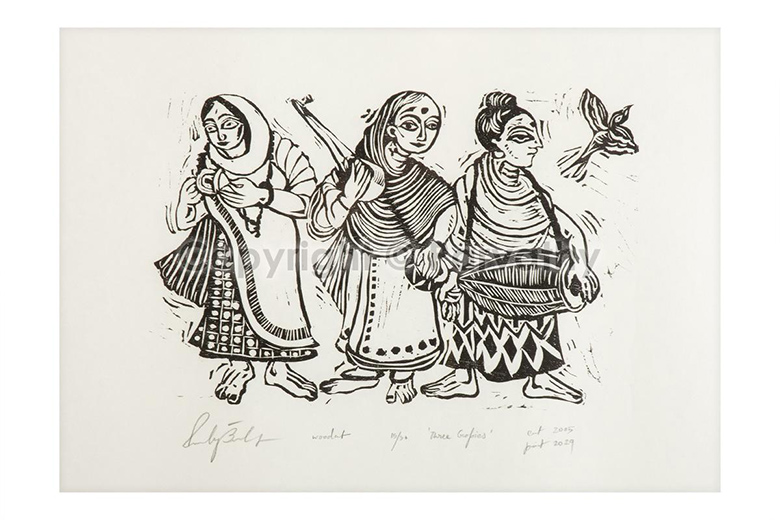
Parvathy Baul: Gopi Bhava, 2005
Dimensions: 16.3x25.5 cm, Medium: Woodcut, Sakura ink on japanese paper
Price: 2.000 €
In the path of the Bhakti of Sri Krishna, meditation on his sporting in Brindavan with various denizens plays a pivotal role for the seeker in cultivating true devotion. Amongst all forms of devotion, that which is embodied by the Gopis is considered the most pristine. It is a state of total surrender and an attitude of complete reliance on Sri Krishna. This wood cut depicts three Baul women as the Gopis. Here is a short excerpt from a poem composed by Parvathy Baul on Gopi Bhav.
The Krishna of Vrindavan
Holds the corner of cloth worn by the
Gopis
And takes refuge in their arms.
This Krishna is the embodiment of love,
He is the supreme essence
That everyone worships.

Parvathy Baul: Mayi – The two Saints, 2019
Dimensions: 35.2x26.4 cm, Medium: Woodcut, Sakura ink on japanese paper
Price: 2.500 €
Mayi Amma was a mystic saint referred to as Siddha in Southern India. She spent most of her time in Kanyakumari, southern tip of the Indian Subcontinent. In the later years she lived in Salem, Tamil Nadu. There are many miraculous stories connected to her. People often spotted her floating on the ocean water. She used to enter sea waters and return only after several months. While on the shore, she was always accompanied by dogs. They were her fond followers. Her facial features resembled those of the Northeastern part of the country. Many believed that she possibly came down south from Tibet. Some also believe that she lived for over five hundred years. One cannot establish these beliefs as facts, but nevertheless it was indeed true that she was a great spiritual master and she drew many great beings towards her. She finally took Samadhi in 1984. On another occasion, a great Spiritual master Mata Amritananda Mayi visited Mayi Amma. It was that sacred moment which inspired this woodcut. Here one can see Mayi Amma is seated in the lap of Mata Amritananda Mayi, who in turn is seated in the womb of Svarupa i.e the real form of Mayi Amma. Dog disciples (special beings) are surrounding them.
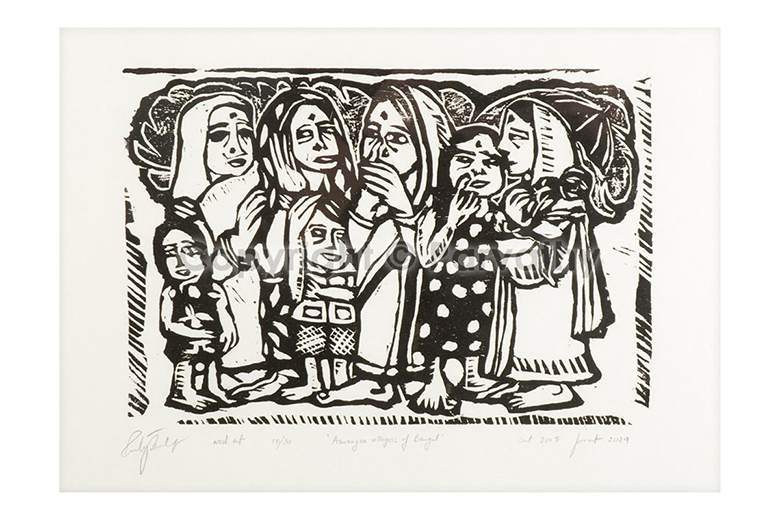
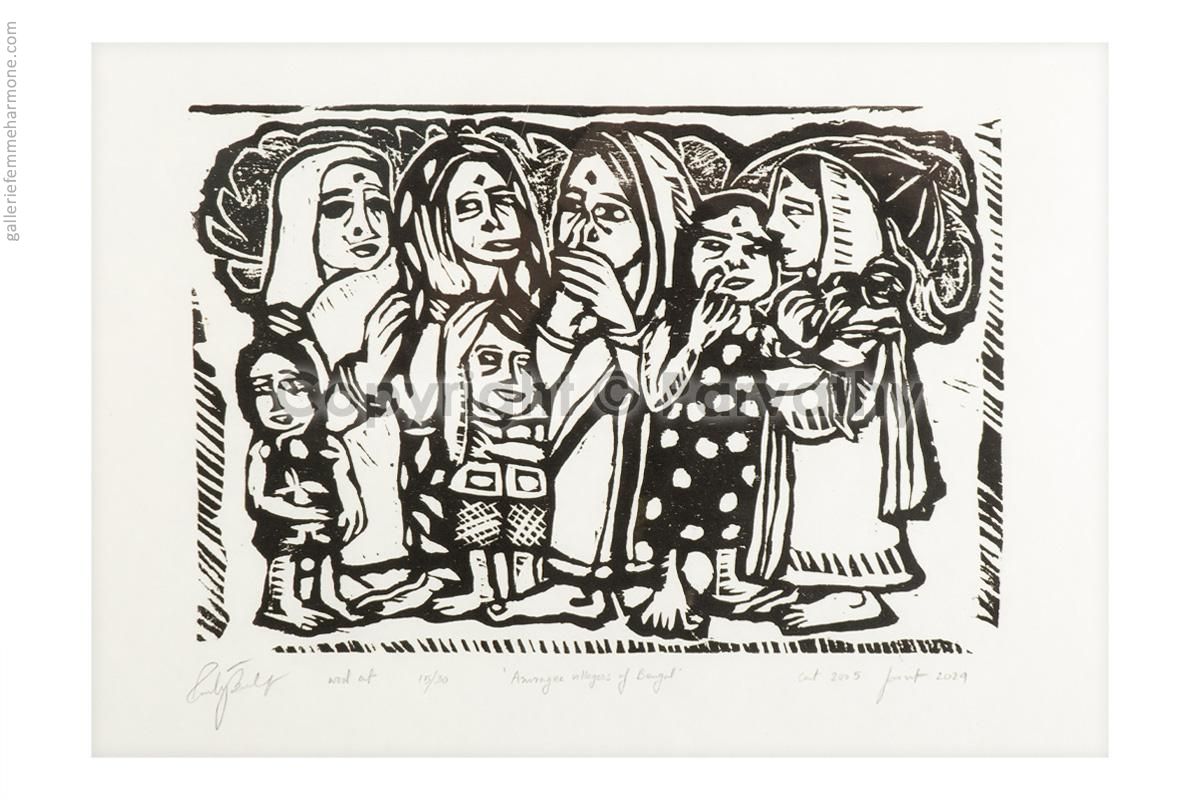
Parvathy Baul: The Villagers (Baul Anuragee), 2003
Dimensions: 17.2x25.5 cm, Medium: Woodcut, Sakura ink on japanese paper
Price: 1.500 €
As part of the Baul daily practice, a sadhak needs to go for Madhukori which means ‘gathering honey’. In this process a Baul goes from door to door in the villages and sings Hari Nam. During these sacred trips, I would meet curious, loving, and tender villagers who actually supported the Baul path over several generations. This woodcut depicts a family of Baul Anuragee.